CASE STUDY
Intensive commercial pork production faces two constant, competing operational pressures: maximizing feed efficiency to protect profit margins and mitigating environmental impacts, specifically toxic ammonia emissions. A pivotal peer-reviewed study published in the Journal of Animal Science investigated the systemic effects of supplementing pig diets with various standardized humic substances (HS).
The empirical data demonstrates that specific dietary humic and fulvic acid profiles function as highly effective, natural performance enhancers. By stabilizing the gastrointestinal tract and altering nutrient metabolism, these intelligent feed additives not only improve Average Daily Gain (ADG) and Gain-to-Feed (G:F) ratios but also significantly enhance premium carcass characteristics and dramatically reduce volatile ammonia emissions. This provides a multi-tiered economic and environmental advantage for large-scale pork operations.
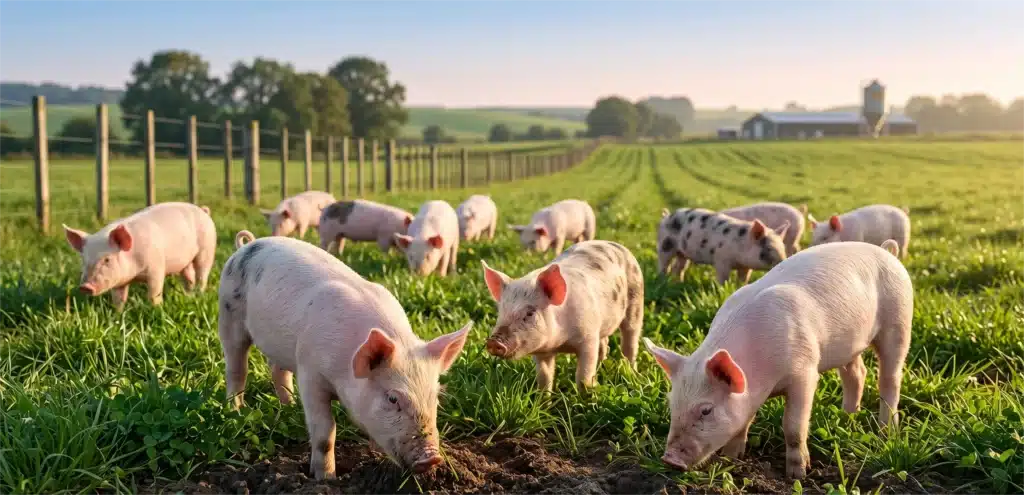
The Evidence (Data Highlights) The comprehensive study evaluated multiple experiments utilizing distinct humic substance profiles (varying in fulvic and humic acid concentrations) integrated into standard phase-feeding programs. The measured outcomes yielded statistically significant (P < 0.05) improvements across three core commercial metrics:
Growth Performance & Feed Conversion:
Enhanced Growth Efficiency: During critical growth phases, pigs fed diets supplemented with an optimal 0.2% humic substance profile exhibited greater Average Daily Gain (ADG) and improved Gain-to-Feed (G:F) ratios compared to standard control diets, indicating superior nutrient utilization.
Carcass Characteristics & Premium Yield:
Increased Marbling Scores: At harvest, pigs receiving the 0.2% HS dietary intervention demonstrated a statistically significant increase in objective marbling scores compared to the control group. This shift directly impacts meat quality grading and premium packer matrices.
Facility Health & Environmental Control:
Ammonia Emission Reduction: The most profound operational metric recorded was a validated 16% reduction in ammonia emission (P = 0.02) from the manure of pigs fed the 0.2% humic substance diet, showcasing a direct chemical alteration in nitrogen excretion and volatility.
Business Impact In commercial pork integration, feed constitutes the single largest variable cost. The data confirms that utilizing specific humic substances directly improves the Gain-to-Feed ratio, meaning more pork is produced per ton of feed consumed—a direct and measurable increase in ROI. Furthermore, the documented increase in meat marbling unlocks potential premium pricing at the packing plant, increasing total revenue per head.
Equally critical is the 16% reduction in ammonia emissions. High facility ammonia levels induce severe respiratory stress in both livestock and human workers, depressing feed intake, increasing mortality, and requiring aggressive, costly ventilation strategies. By biologically binding nitrogen in the manure matrix before it volatilizes, humic acid additives proactively improve facility air quality, lower energy costs associated with ventilation, and reduce overall veterinary interventions.
Why Humicore This research underlines a critical fact: the physiological benefits are completely dependent on the specific profile and concentration of the humic and fulvic acids used. Generic organic matter does not yield a 16% drop in ammonia. Achieving these precise, replicable outcomes requires highly stable, intelligently engineered feed additives.
Humicore’s “Intelligent Nutrition” solutions are specifically calibrated for this commercial reality. Our feed-grade humates are scientifically standardized to deliver the exact bioactive fractions required to optimize the gut microbiome, maximize nutrient absorption, and bind volatile nitrogen. We provide the agricultural industry with consistent, heavily tested nutritional tools that translate academic science into reliable operational profitability.
Conclusion Maximizing herd performance while managing facility environments requires precision nutrition. The evidence is conclusive: integrating high-quality, targeted humic substances into pork diets fundamentally improves feed conversion, elevates meat quality, and suppresses toxic emissions.
Are feed costs, respiratory challenges, or facility ammonia levels threatening your production margins? Contact the Humicore Animal Health division today for a technical consultation. Discover how our advanced humate feed additives can optimize your nutritional programs and drive sustainable profitability across your operation.