CASE STUDY
The global cauliflower and broccoli market, valued at a massive $27.9 billion in 2024, is under constant threat from environmental degradation. Currently, 20 percent of cultivated land and 33 percent of irrigated land worldwide are affected by salinity. For moderately salt-sensitive crops like cauliflower, yield depreciation begins at a severely restrictive threshold of 1.9 to 2.7 dS/m. This article synthesizes peer-reviewed agronomic data with macroeconomic trends and processing technology, demonstrating how combining precision drip irrigation, in-line moisture control, and advanced humic acid engineering can mitigate osmotic stress, recover lost yields, and build permanent soil assets.
The Evidence (Data Highlights):
Rigorous greenhouse trials testing the interaction of sodium chloride (NaCl) and humic acid (HA) on cauliflower yield provide definitive proof of biological mitigation:
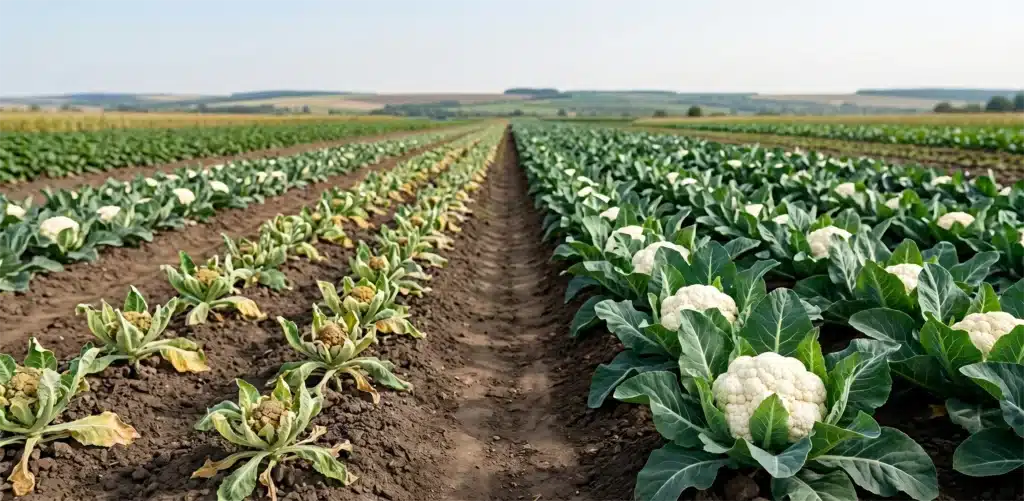
Yield Preservation: At a moderate salinity stress of 4 dS/m, unamended soil yielded 3280.35 kg/da. The addition of 2 g/kg HA increased the marketable yield to 3422.14 kg/da, rescuing over 141 kg per decare.
Physical Dimensionality: Under 2 dS/m of salt stress, untreated plants produced curds with an average diameter of 15.13 cm. Integrating 2 g/kg HA expanded the curd diameter significantly to 18.55 cm.
Biochemical Quality: The highest dry matter concentration in the entire study, 11.26 percent, was achieved when 6 dS/m salinity was combined with 2 g/kg HA.
Mechanical Synergy: Drip irrigation provides a 95 percent water distribution uniformity and helps maintain average soil salinity at a more manageable 3.60 dS/m. Post-harvest, HumiCore Pro in-line sensors provide precision moisture measurements of 0.1 to 0.3 percent to maximize commercial processing profitability.
Business Impact: In an agricultural landscape where fresh cauliflower wholesale prices experience extreme volatility—ranging from $0.23 to $1.43 per kg in 2024—the margin for agronomic error is practically nonexistent. Allowing moderate salinity to stunt curd diameter and reduce total tonnage directly destroys gross revenue per hectare. By applying premium humates, growers not only recover lost weight but also capitalize on the “salinity paradox,” where the plant naturally increases internal dry matter and total soluble solids in response to stress. This translates to a heavier, denser, and higher-quality harvest capable of commanding premium market pricing.
Why Humicore
Treating soil health as a temporary expense is a flawed agronomic model; commercial survival requires transitioning to Asset-Based Farming. While basic humates provide baseline buffering, Humicore’s ultrasonic nano-form extraction creates an adaptive humic engine boasting up to 80 percent purity. Our proprietary 30-micron ultra-filtration process guarantees a sediment-free liquid that is 100 percent safe for the automated drip irrigation systems required to manage salinity without the risk of clogging. The Humicore Raw, Humicore Matrix, and Humicore Vita portfolios are standardised to buffer osmotic stress, unlock bound nutrients, and maximise harvestable curd mass across GCC soil and climate conditions.
Conclusion
Protecting yield and fertilizer efficiency in saline environments requires proactive, data-driven soil management. The scientific evidence is clear: integrating premium humic acid into your agronomic program is a proven strategy to recover curd diameter, rescue harvestable tonnage, and permanently elevate the biological productivity of your soil.
Is soil salinity suppressing your Brassica yields or reducing the value of your harvest? Contact the Humicore Soil Technology division today for a technical consultation. Discover how integrating the Humicore Raw, Humicore Matrix, or Humicore Vita portfolios can eradicate osmotic drag and permanently elevate your farm’s biological valuation.