
CASE STUDY
Humic acid products occupy an unusual space in professional turfgrass management. Marketed as soil conditioners, nutrient chelators, and stress-mitigation agents, they command a significant share of the premium turf inputs market — yet peer-reviewed agronomic evidence on their performance under real fairway conditions remains scarce. Most studies examining humic acid turfgrass applications rely on greenhouse data or short observation windows.
A rigorous, sponsor-independent trial conducted at the Guelph Turfgrass Institute (Carey & Gunn, 2000) set out to fill that gap — running four commercial humic acid products across 18 weeks of a full growing season on creeping bentgrass maintained at fairway height. The findings are instructive for any turf manager evaluating whether humate applications justify their place in a fertility program.
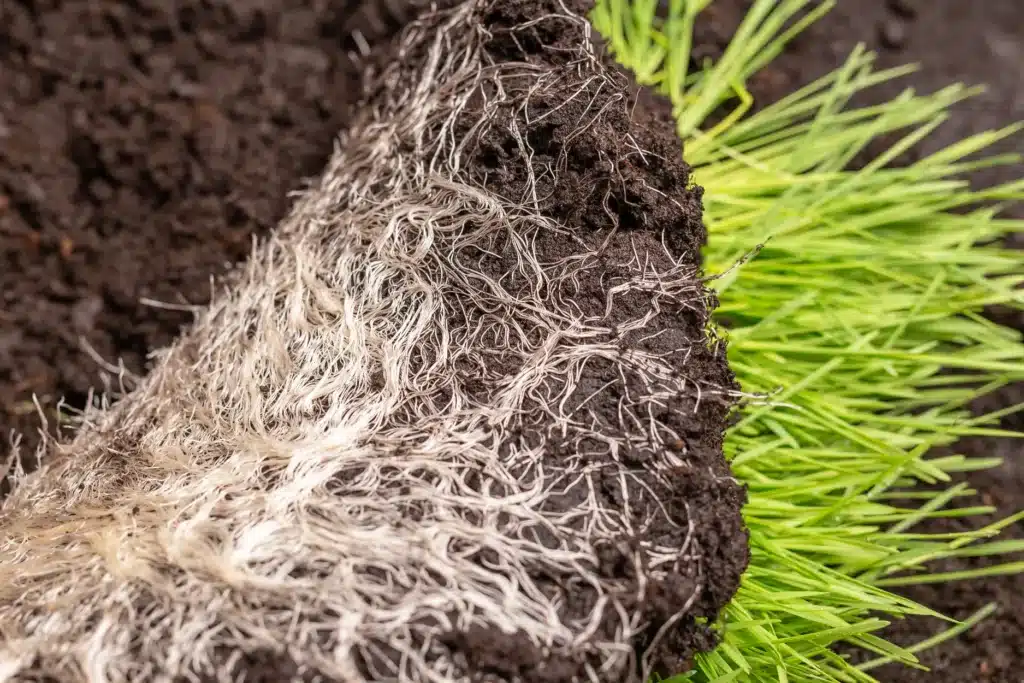
Bentgrass fairways demand precision. Mowed at 11 mm or lower, they are among the most intensively managed surfaces in commercial horticulture — responsive to even small differences in nutrient availability, soil biology, and moisture regime. This sensitivity makes bentgrass an ideal test system for evaluating whether humic acid products produce measurable agronomic effects beyond what a standard N-P-K program delivers.
In practice, turfgrass managers frequently encounter claims that humic substances improve root development, unlock micronutrient availability, and buffer plants against heat or drought stress. The Guelph trial was designed to generate statistically controlled data on precisely these variables — giving practitioners a credible basis for purchasing decisions rather than anecdote.
The study is also relevant to a growing interest in humic acid applications in GCC sports turf and landscaping, where sandy, nutrient-poor rootzones, alkaline pH, and recurring drought conditions create an agronomic profile that could, in theory, favour humate interventions.
The trial tested four commercial humic acid products — two liquid and two granular formulations — against three controls: an untreated blank, a macronutrient-only control (N-P-K), and a micronutrient control (N-P-K + Cu-Zn-Fe at levels matching those present in the humic products). Each treatment was replicated five times in a randomised complete block design, applied to 1 × 4 m plots.
Measurements covered every relevant performance variable:
Products were applied monthly from May through September at sponsor-specified rates, with liquid treatments drenched at 7 L water m⁻². The bentgrass received no herbicide or fungicide treatments throughout, and irrigation was withheld in the second half to induce drought stress — though natural precipitation prevented that stress from developing meaningfully.
All humic acid treatments consistently maintained turf quality scores within the acceptable fairway range. However, the critical agronomic question — whether humates outperform an equivalent fertility program without humic acid — is where the data becomes nuanced.
Turf performance (visual and instrumental): All plots receiving N-P-K fertilisation — with or without humic acid — significantly outperformed the untreated check by week three and maintained that advantage through the season. Colour, density, uniformity, and overall quality scores were statistically indistinguishable among the N-P-K treated groups. Neither the micronutrient addition nor the humic acid products produced a further significant improvement over standard N-P-K fertilisation in any visual or colorimetric parameter.
Shoot growth (clipping yield): As expected, fertilised plots produced more shoot biomass than the untreated control. No significant difference in dry matter accumulation was detected among the fertilised treatments — meaning neither the granular nor the liquid humic acid products altered shoot growth rates relative to the macronutrient or micronutrient controls.
Root systems: No significant treatment effects were found for root length, root size rating, or root dry mass at either sampling point. A seasonal reduction in root length combined with an increase in root mass is a normal response in bentgrass during the summer period and was consistent across all plots.
Tissue nutrient content: This is where the data shows the most interesting signal. While macronutrient levels (N and K) tracked predictably with fertiliser inputs, micronutrient tissue content showed treatment-linked patterns. Copper and zinc increased in all fertilised plots, but most prominently in the micronutrient control and in liquid humic product L168. Manganese was highest in the granular product L157 and liquid product L168. These differences did not translate into detectable differences in growth, colour, or root development under the conditions of this trial.
Soil chemistry: Seasonal changes were recorded in several soil parameters (P and Mn declined; K, Mg, and Fe increased over the season), but none were attributable to specific treatments. Soil pH remained stable across all plots, ranging from 7.64 to 7.74 throughout.
The authors draw a conclusion that is directly relevant to any humic acid purchasing decision: the relatively benign growing conditions of the 2000 season — no significant drought, no disease pressure, adequate natural precipitation — may have masked any treatment effects that humic acid products could produce under stress. The literature on humate bioactivity consistently points to stressed systems — poor rootzones, heat and drought events, disease-prone conditions — as the environment where humic acid interventions show their strongest agronomic return.
A well-fertilised bentgrass fairway in a season without meaningful stress is effectively a low-sensitivity test system. If humic substances primarily function by enhancing nutrient chelation and soil water retention under limiting conditions, it follows logically that a trial without those limiting conditions would show a flat treatment response — not because the product is inert, but because the soil-plant system was not in a state where the product’s mechanisms would be activated.
For turf managers, the Guelph data supports a targeted rather than blanket approach to humic acid use. Applications are most defensible where there is a defined stress condition — sandy, low-CEC rootzones with poor nutrient retention; profiles with alkaline pH that lock out iron and manganese; recovery periods after heat, drought, or disease events; or renovation programs where root establishment is a priority.
The trial also underscores the importance of selecting a product with measurable functional group activity rather than treating humic acid as a commodity input. The differences in micronutrient tissue content between the four tested products — while not statistically significant for growth outcomes in this trial — suggest that product quality and formulation do influence chelation dynamics in plant tissue. Premium-grade leonardite-derived humates with standardised functional group density are not agronomically equivalent to lower-grade organic amendments, even if both carry a “humic acid” label.
Humicore’s advanced soil technologies are designed for precisely this operational context. Derived from premium leonardite deposits and processed to ensure reliable functional group density, our liquid and granular humic formulations are engineered to deliver measurable chelation activity and soil conditioning performance — particularly in the high-pH, low-organic-matter soil profiles common across the GCC. We recommend applying them as part of a targeted program where rootzone conditions or seasonal stress make humate intervention most agronomically sound.