
CASE STUDY
Potato is one of the most nutrient-demanding staple crops in commercial agriculture. Sustaining consistently high marketable yield — the fraction of the harvest that actually generates revenue — requires not just adequate fertiliser input, but a soil environment capable of delivering those nutrients to the root system efficiently. Standard N-P-K programmes often fall short in soils with poor organic matter, high pH, or limited water retention capacity, leaving applied nutrients partially stranded in unavailable forms.
A two-season field study by Sanli, Karadogan, and Tonguc (Süleyman Demirel University, published in the Turkish Journal of Field Crops, 2013) provides rigorous, peer-reviewed data on what happens when leonardite — a concentrated source of humic and fulvic acids with 54.5% organic matter — is added to the standard fertilisation program of four commercial potato cultivars. The results are clear and commercially significant: leonardite applications at 400 kg ha⁻¹ increased marketable tuber yield by 38%, tuber count per plant by 22%, and total yield by 15% compared with fertiliser-only controls, across two growing seasons.
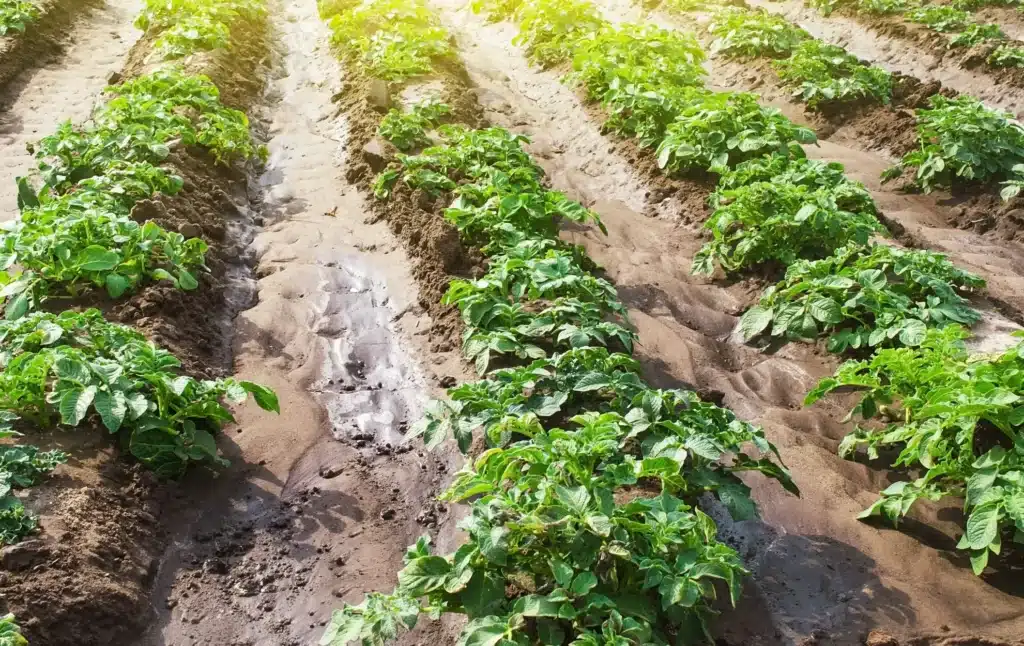
Leonardite is a naturally oxidised form of lignite, formed near the Earth’s surface through prolonged weathering. Unlike coal, it never fully compacted — and that partial decomposition is precisely what concentrates its agronomic value. Its humic acid content can reach 30–80% depending on deposit source, and it carries a high cation exchange capacity (CEC) that allows it to physically bind and retain cations — including the potassium, iron, and manganese that potato plants require in substantial quantities.
The mechanisms through which leonardite improves potato performance are well-documented in the broader humic substances literature:
The study ran across two full growing seasons (2008 and 2009) on loam soil with a pH of 8.2 — a moderately alkaline profile characteristic of many commercial potato-growing regions in the Middle East and Central Asia, where phosphorus fixation and micronutrient lock-up are common production constraints.
Four leonardite dose levels — 0, 200, 400, and 600 kg ha⁻¹ — were tested across four commercially important cultivars: Agata (very early), Milva (mid-early), Van Gogh (mid-late), and Lady Olympia (late). Leonardite was broadcast at planting alongside a uniform N-P-K base programme (200 kg ha⁻¹ N, 100 kg ha⁻¹ P). The experiment used a randomised complete block design with three replications.
Seven traits were measured across both seasons: plant height, tubers per plant, marketable tuber yield (>45 mm), total tuber yield, protein content, vitamin C content, and specific gravity. Statistical analysis used ANOVA with Duncan’s multiple range test at the 0.05 significance level.
Critically, the data shows a clear dose-response relationship up to 400 kg ha⁻¹ — and then a plateau. The difference in marketable yield, total yield, protein content, and vitamin C between the 400 and 600 kg ha⁻¹ treatments was not statistically significant in any cultivar or season. This is a commercially important finding: escalating leonardite application beyond 400 kg ha⁻¹ adds input cost without producing a measurable agronomic return.
Marketable tuber yield responded most dramatically to leonardite input — and this is the metric that matters most commercially, since sub-45 mm tubers are typically sold at a discount or rejected entirely. The average marketable yield in the control group was 17.5 t ha⁻¹. At 200 kg ha⁻¹ leonardite, this rose to 20.6 t ha⁻¹ (+18%). At 400 kg ha⁻¹, it reached 23.0 t ha⁻¹ (+31%), and at 600 kg ha⁻¹, 24.1 t ha⁻¹ (+38%). For three of four cultivars — Van Gogh, Milva, and Lady Olympia — the absolute yield gains at 400 kg ha⁻¹ ranged from 4.6 to 9.1 t ha⁻¹ per hectare compared with the control. At commercial potato prices, these are economically significant margins.
Tuber quality parameters improved alongside yield. Protein content rose from an average of 1.94% (control) to 2.08–2.12% at the two highest leonardite doses — a 7–9% relative increase that improves the nutritional profile of fresh-market and processing potatoes alike. Vitamin C content followed a similar trajectory: the control average of 16.3 mg 100 g fw⁻¹ increased to 18.6 mg 100 g fw⁻¹ at 400 kg ha⁻¹. Specific gravity — a proxy for dry matter and starch content, and a direct quality metric for the processing industry — also increased significantly versus the control, though differences between leonardite doses were not significant, suggesting that even modest leonardite application is sufficient to improve tuber dry matter accumulation.
The cultivar effect is real and important. Agata, the very-early cultivar with the shortest growing season, showed the weakest yield response to leonardite across all dose levels — marketable yield remained below 13.2 t ha⁻¹ regardless of dose, compared with 25–29 t ha⁻¹ for Milva and Lady Olympia at the highest dose. This suggests that very early cultivars with compressed tuber-bulking windows may not fully capture the soil-conditioning benefits of leonardite within a single growing season, whereas mid-season and late cultivars — with longer periods of active root-soil interaction — show the strongest response.
The Isparta trial data establishes an evidence-based agronomic case for leonardite as a yield-enhancing soil amendment in potato production, particularly in alkaline soils where nutrient availability constraints are common. The key practical takeaways are straightforward. 400 kg ha⁻¹ is the agronomically optimal and economically rational dose — it delivers statistically equivalent results to 600 kg ha⁻¹ at lower input cost. Leonardite should be broadcast at planting and incorporated alongside the standard N-P fertilisation programme, not applied as a standalone product. Cultivar selection interacts with leonardite response: mid-season and late varieties that allow full expression of the soil-conditioning effect tend to show the highest absolute yield gains.
These findings are consistent with a broad body of published research on humic acid applications in potato, including work by Hopkins & Stark (2003), Verlinden et al. (2009), and Mahmoud & Hafez (2010), all of which report significant yield increases from humate soil amendments across different soil types and geographies.
The agronomic outcomes documented in this trial — a 38% gain in marketable yield, improved protein and vitamin C content, higher specific gravity — are only achievable with a leonardite source that meets specific quality thresholds. The product tested contained 54.5% organic matter and 50.5% humic + fulvic acids with a measured CEC and pH of 6.80. Generic organic amendments labelled “humic acid” do not reliably deliver these functional group densities or the chelation performance they enable.
Humicore’s leonardite products are sourced from premium-grade deposits and processed to consistent specifications, ensuring that the humic and fulvic acid fractions responsible for pH buffering, nutrient chelation, and water retention are present at agronomically active concentrations in every application. For commercial potato producers targeting consistent marketable yield improvements across seasons, this quality consistency is not a premium — it is a prerequisite.